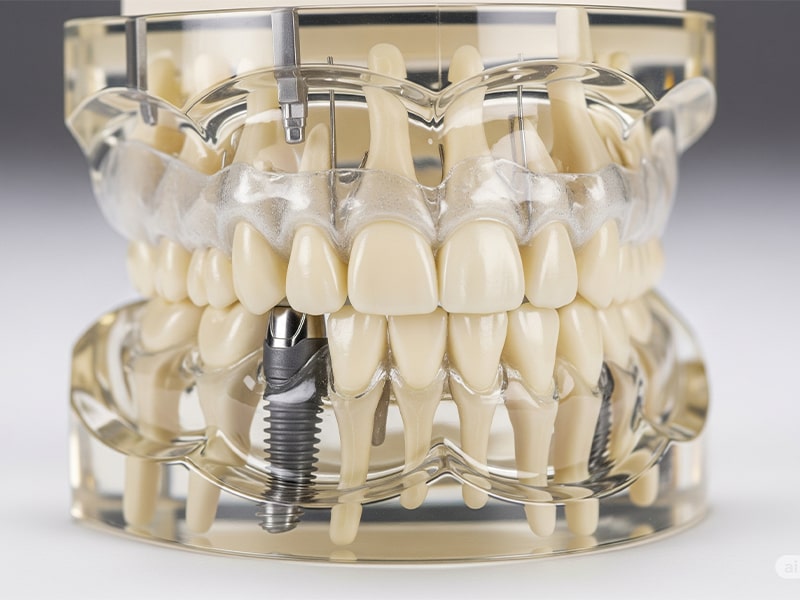
Maxillofacial surgery guides
Maxillofacial surgery is one of the most intricate branches of modern dentistry and medicine, encompassing a range of procedures that address skeletal deformities, facial trauma, tumors, and complex dental surgeries such as implant placement in high-risk areas.
With the advancement of digital technologies, maxillofacial surgical guides have become essential tools for enhancing precision, safety, and predictability during complex procedures. This article explores what surgical guides are, their applications in oral and maxillofacial surgery, their design process, types, and the advantages they offer over traditional techniques.
________________________________________
What Is a Maxillofacial Surgical Guide?
A surgical guide in the context of maxillofacial surgery is a custom-designed, 3D-printed or CNC-milled device used to guide instruments such as drills, saws, or scalpels during surgery.
Created using CBCT scans, intraoral scans, and CAD software, these guides are tailored to the patient’s anatomy and provide precise guidance for incision lines, bone cuts, implant placement, and more. They ensure that surgical actions follow a pre-planned, digitally simulated path with high accuracy.
________________________________________
Applications of Surgical Guides in Maxillofacial Surgery
Maxillofacial surgical guides are used in a wide range of procedures, including:
• Reconstructive surgery following trauma or bone loss
• Orthognathic (jaw repositioning) surgery
• Tumor and cyst removal in the jaws
• Precise placement of dental implants in atrophic or anatomically sensitive zones
• Wisdom tooth extractions near the mandibular nerve or sinus cavity
• Combined surgeries involving orthodontic and facial aesthetic planning
________________________________________
Steps for Designing and Fabricating Surgical Guides
1. Data Acquisition
High-resolution CBCT scans and intraoral scans or STL files are taken to capture the patient’s jawbone, teeth, and soft tissue anatomy.
2. Digital Planning Using CAD Software
The surgeon and technician collaboratively plan the surgery using specialized software, marking exact locations for osteotomy, drilling, or implant insertion.
3. Guide Fabrication
The surgical guide is manufactured using 3D printing (resin or biocompatible plastic) or CNC milling depending on the complexity and required material strength.
4. Verification and Fit Test
The guide is tested on a dental model or in the patient’s mouth before surgery to ensure perfect fit and alignment.
________________________________________
Benefits of Using Maxillofacial Surgical Guides
• Enhanced Accuracy: Millimeter-level precision in bone cutting or drilling
• Reduced Operating Time: Predefined path reduces time spent on intraoperative decision-making
• Minimized Risk of Damage: Avoids critical structures like nerves, blood vessels, and sinuses
• Predictable Outcomes: Pre-surgical simulation improves result consistency
• Improved Patient Safety and Satisfaction: Less invasive procedures and fewer complications
• Decreased Need for Revision Surgeries: First-time success reduces long-term costs and trauma
________________________________________
Types of Maxillofacial Surgical Guides
1. Implant Surgical Guides
Used for guided placement of dental implants in complex cases with limited bone or proximity to critical anatomical features.
2. Orthognathic Surgical Guides
Custom guides for repositioning jaws (mandible or maxilla) to correct skeletal Class II, Class III, or open bite conditions.
3. Tumor Resection Guides
Designed for accurate removal of benign or malignant lesions while preserving surrounding bone and soft tissue.
4. Wisdom Tooth Removal Guides
Useful in cases where third molars are close to the mandibular nerve or embedded in dense bone.
5. Combined Aesthetic and Functional Surgical Guides
Incorporating data from orthodontic and prosthetic planning for facial harmony and restoration.
________________________________________
Traditional Surgery vs. Guided Surgery
Feature Traditional Surgery Guided Maxillofacial Surgery
Precision Depends on surgeon's experience Based on digital 3D planning
Operating time Longer Shorter
Safety near critical anatomy Variable Highly controlled
Predictability of outcome Moderate High
Revision surgery likelihood Higher Significantly reduced
Cost of equipment Lower Higher, but more efficient
________________________________________
Post-Operative Care After Guided Surgery
• Follow prescribed antibiotics and anti-inflammatories
• Avoid applying pressure to the surgical site
• Maintain oral hygiene with non-alcoholic mouth rinses
• Stick to a soft diet for several days post-surgery
• Avoid smoking and alcohol to promote tissue healing
• Attend follow-up appointments for wound inspection and healing assessment
________________________________________
Do All Maxillofacial Surgeries Require a Surgical Guide?
Not necessarily. While surgical guides are highly beneficial in complex and high-risk cases, simpler procedures may not justify the additional planning and production time.
Indications for surgical guide usage include:
• Severe bone loss
• Close proximity to vital structures (e.g., inferior alveolar nerve, maxillary sinus)
• Multi-implant placement with angulation considerations
• Tumor resection with need for precise margins
• Reconstructive surgery requiring facial symmetry
________________________________________
Future of Surgical Guides in Maxillofacial Surgery
With continuous development in digital dentistry, artificial intelligence, and intraoperative navigation systems, surgical guides are evolving to become even more interactive. Integration with real-time feedback tools, robotics, and augmented reality will further revolutionize maxillofacial surgery in the coming years.
________________________________________
Conclusion
Maxillofacial surgical guides represent a major advancement in precision surgery. They empower oral and maxillofacial surgeons to perform complex operations with confidence, accuracy, and reduced risk. Whether for implant placement, orthognathic correction, or tumor resection, surgical guides offer a level of control and predictability that was once unimaginable.
For patients, this translates into safer, faster procedures and better long-term outcomes.
________________________________________